


How Critical Systems Stay Alive During Blackouts
Introduction
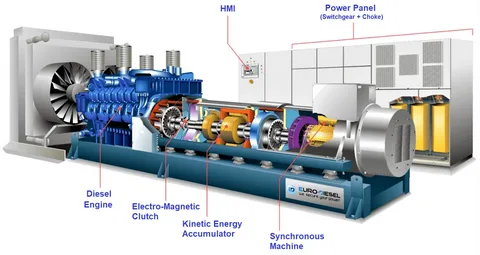
The rotary uninterruptible power supply market focuses on robust power protection systems that combine mechanical and electrical technologies to deliver continuous and stable electricity during power disturbances. Unlike static UPS systems that rely only on batteries and power electronics, rotary UPS systems use rotating machines such as flywheels and motor-generators to store and deliver energy. These systems are widely used in heavy-duty and mission-critical applications such as data centers, hospitals, airports, manufacturing plants, and telecom facilities where even a brief power interruption can cause serious operational and financial losses. Rotary UPS systems are valued for their high power capacity, long service life, and ability to handle large electrical loads with high reliability. As industries become more sensitive to power quality and downtime, the demand for rotary UPS solutions continues to grow.
Market Drivers
The growth of the rotary uninterruptible power supply market is mainly driven by the rising need for reliable and uninterrupted power in critical infrastructure. Data centers require continuous power to protect servers and prevent data loss, while hospitals and emergency services depend on stable electricity for life-saving equipment. Rapid digitalization, cloud computing, and expansion of telecom networks are further boosting demand for high-capacity UPS systems. Rotary UPS units are preferred in applications where high power rating, fast response time, and long backup duration are required. Increasing frequency of power fluctuations, grid instability, and voltage disturbances in many regions is also pushing industries to invest in stronger power protection solutions. The ability of rotary UPS systems to support both power conditioning and backup generation in a single integrated setup is another key factor driving market growth.
Market Challenges
Despite strong demand, the rotary uninterruptible power supply market faces several challenges that can limit wider adoption. One of the main challenges is the high initial investment required for purchasing and installing rotary UPS systems compared to static UPS units. These systems also require more physical space due to their mechanical components, which can be a limitation in space-constrained facilities. Regular mechanical maintenance and the need for skilled technicians increase operating and servicing costs. Noise and vibration generated by rotating equipment can be an issue in certain environments if not properly managed. In some applications, advances in high-capacity static UPS systems are increasing competition and influencing purchasing decisions based on lower upfront cost and compact design.
Market Opportunities
The rotary uninterruptible power supply market offers strong opportunities with the continuous expansion of data centers, industrial automation, and critical infrastructure projects. Large hyperscale data centers require high-capacity and reliable power protection that rotary UPS systems can efficiently provide. Growth in renewable energy integration is also creating opportunities for rotary UPS systems to stabilize power fluctuations from variable energy sources. Modernization of aging industrial power infrastructure is another area creating demand for durable backup power solutions. Technological advancements aimed at improving flywheel efficiency, reducing footprint, and lowering maintenance requirements are making rotary UPS systems more attractive to a wider range of users. Emerging markets with expanding industrial and digital infrastructure also present long-term growth potential.
Regional Insights
Regional demand for rotary uninterruptible power supply systems varies based on industrial activity, digital infrastructure growth, and power reliability. North America represents a major market due to the strong presence of data centers, telecom networks, and industrial facilities that require high-capacity power protection. The United States, in particular, has seen rising demand from cloud service providers and colocation data centers. Europe is another important market driven by industrial automation, strong data protection regulations, and expansion of digital infrastructure in countries such as Germany, the United Kingdom, and the Netherlands. The Asia-Pacific region is witnessing rapid growth due to fast industrialization, expansion of telecom networks, and massive data center construction in countries such as China, India, Japan, and Singapore. Rising investment in manufacturing and smart infrastructure in this region is further strengthening market demand. Other regions such as the Middle East and Latin America are gradually adopting rotary UPS systems to support expanding industrial zones and digital services.
Future Outlook
The future of the rotary uninterruptible power supply market appears stable and positive as demand for high-reliability power protection continues to rise. Continuous innovation in flywheel design, motor efficiency, and digital monitoring systems will enhance system performance and reduce maintenance burden. Integration of rotary UPS systems with smart grid platforms and backup generators will improve overall energy resilience for critical facilities. As renewable energy sources become a larger part of the power mix, rotary UPS systems will play an important role in smoothing voltage and frequency variations. Growing construction of data centers, smart factories, and automated facilities will further strengthen long-term market growth. Rotary UPS systems are expected to retain their importance in high-power and mission-critical applications.
Conclusion
The rotary uninterruptible power supply market is a vital segment of industrial and critical power infrastructure, providing reliable backup and power conditioning for applications that cannot tolerate power interruptions. These systems deliver high performance, long service life, and strong load-handling capability through a combination of mechanical and electrical technologies. While challenges related to cost, space, and maintenance remain, continuous technological improvement and rising demand for power reliability are steadily strengthening market adoption. Strong growth in data centers, industrial automation, and digital services is driving long-term market expansion. The rotary UPS market is therefore expected to maintain its importance as a backbone of reliable power protection solutions.

 English
 Arabic
 French
 Spanish
 Portuguese
 Deutsch
 Turkish
 Italiano
 Russian
 Romaian
 Portuguese (Brazil)
 Greek
Greek
